The short answer: in winter, flowers need several layers of paper around them, as little time outdoors as possible, never a wait in a cold car, and a gradual warm-up once you get home. Get those four things right and a bouquet will survive the trip even on a properly cold day.
In Lithuania a lot of flowers are bought in the cold months: for Christmas and New Year, Valentine's Day, March 8, birthdays and name days. So it is worth knowing how to get them from the florist to the vase without losses.
Why frost harms flowers
Cut flowers are mostly water. When the temperature drops below zero, the water in the cells of petals and leaves starts to freeze, and ice crystals damage the tissue. As those areas thaw, they turn glassy and translucent, darken and go limp. Once that has happened, it cannot be reversed.
The tricky part is that the damage often does not show straight away. Outside, the bouquet looks fine. A few hours later, in a warm room, the edges of the petals turn brown. Wind makes the cold much harsher, so a few degrees below zero with a wind can do more harm than calmer, colder air.
Tropical flowers such as orchids and anthuriums are the most sensitive, along with anything with thin, delicate petals. Hardier flowers such as chrysanthemums and carnations cope better with a short exposure, but they will not survive a long spell in the cold unprotected either.
How to wrap a bouquet for winter
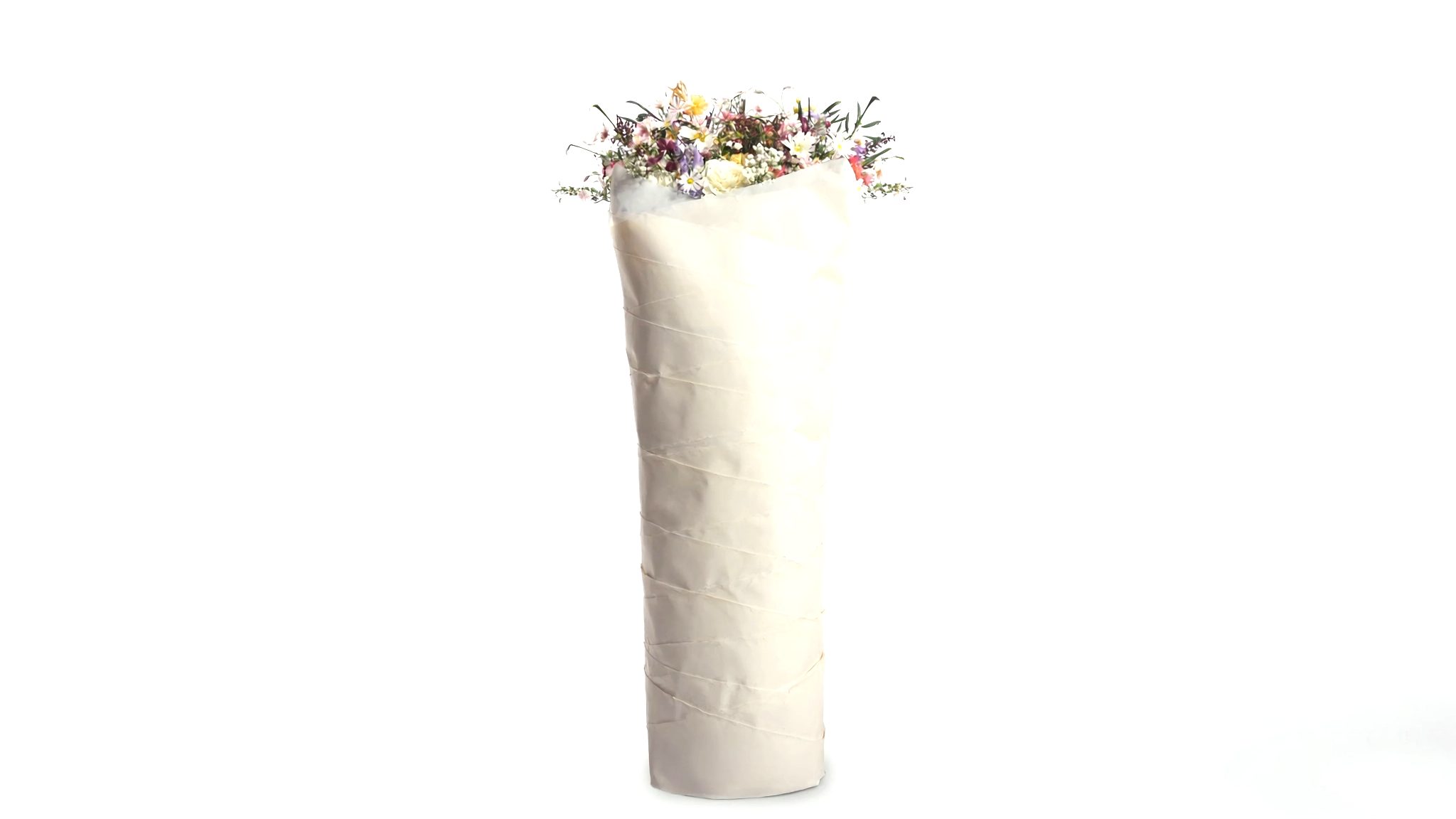
Ordinary decorative wrapping is not enough in winter. Ask for the bouquet to be wrapped for cold weather.
- Several layers of paper work better than one thick one. Air is trapped between the layers, and that air is what insulates.
- The flower heads should be covered completely, with the top folded over or gathered so cold air cannot get in from above.
- A thin plastic film gives almost no warmth on its own, but it does block the wind. It is useful together with paper, not instead of it.
- For a larger bouquet, an extra paper bag or a box helps.
- A potted plant such as an orchid should be wrapped whole, pot included, because cold harms the roots too.
Do not open the wrapping on the way, however tempting it is to take a look or show someone.
On foot
If you are walking or taking public transport:
- Take the shortest route. If you have other errands in town, buy the flowers last.
- Hold the bouquet close to your body and shield it from the wind.
- While waiting at a stop, stand somewhere sheltered.
- For a long trip in hard frost, consider a flower box instead. It is easier to protect and easier to carry.
By car
A car is the most comfortable way to get flowers home in winter, but it has its own traps.
- Start the car and let it warm up before you bring the flowers out.
- Put the bouquet inside the cabin, on a seat or in the footwell, not in the boot. The boot is often much colder.
- Do not point a hot air vent straight at the flowers. A sudden blast of heat is almost as bad for them as frost.
- Drive straight home.
The most important rule: do not leave flowers in a cold car. Once the engine is off, a car cools down very quickly in winter, and within half an hour or so it can be nearly as cold inside as out. If you are buying flowers at a supermarket where you still have shopping to do, do everything else first, pick up the flowers last and go straight to the car.
When you get home
Flowers are harmed not only by cold but by a sudden change in temperature. So take it slowly.
- Leave the bouquet wrapped for 15–30 minutes somewhere cooler, such as the hallway, so it warms up gradually.
- Then unwrap it and cut 2–3 cm off the stems at an angle with a sharp knife or secateurs.
- Put the flowers in a clean vase with room-temperature water. Do not use hot water.
- Keep the vase away from radiators and other heat sources.
If you plan to hand the flowers over outdoors, for example when meeting someone at the station, unwrap them only at the moment you give them.
What to do if the petals look frozen
First, do not try to warm the flowers up fast. Do not put them by a radiator, do not use a hairdryer, and do not stand them in hot water.
- Recut the stems and put the flowers in cool water in a cooler room. Give them a few hours.
- If only the outer petals of a rose are affected, gently pull them off. On roses the outer petals often protect the centre, and the bloom underneath may be fine.
- Remove damaged leaves so they do not rot in the water.
- If after a few hours the whole flower head is soft, translucent and dark, it will not recover. Take it out so the rest of the bouquet looks tidy.
Often only part of a bouquet suffers, usually the flowers closest to the edge of the wrapping. The rest, with good care, can still last for days.
A quick checklist before you leave
- Several layers of paper, flower heads fully covered.
- As little time outdoors as possible, flowers bought last.
- Warm the car first and never leave the flowers in it.
- At home, let the bouquet warm up gradually, then unwrap it and put it in water.
Gitanos gėlės is a flower stand inside the Šilas supermarket at A. Baranausko g. 26, Kaunas, open every day 8:00–23:00. If you would like your bouquet ready and waiting, you can pre-order it by SMS at +370 656 38880 or on gitanosgeles.lt.