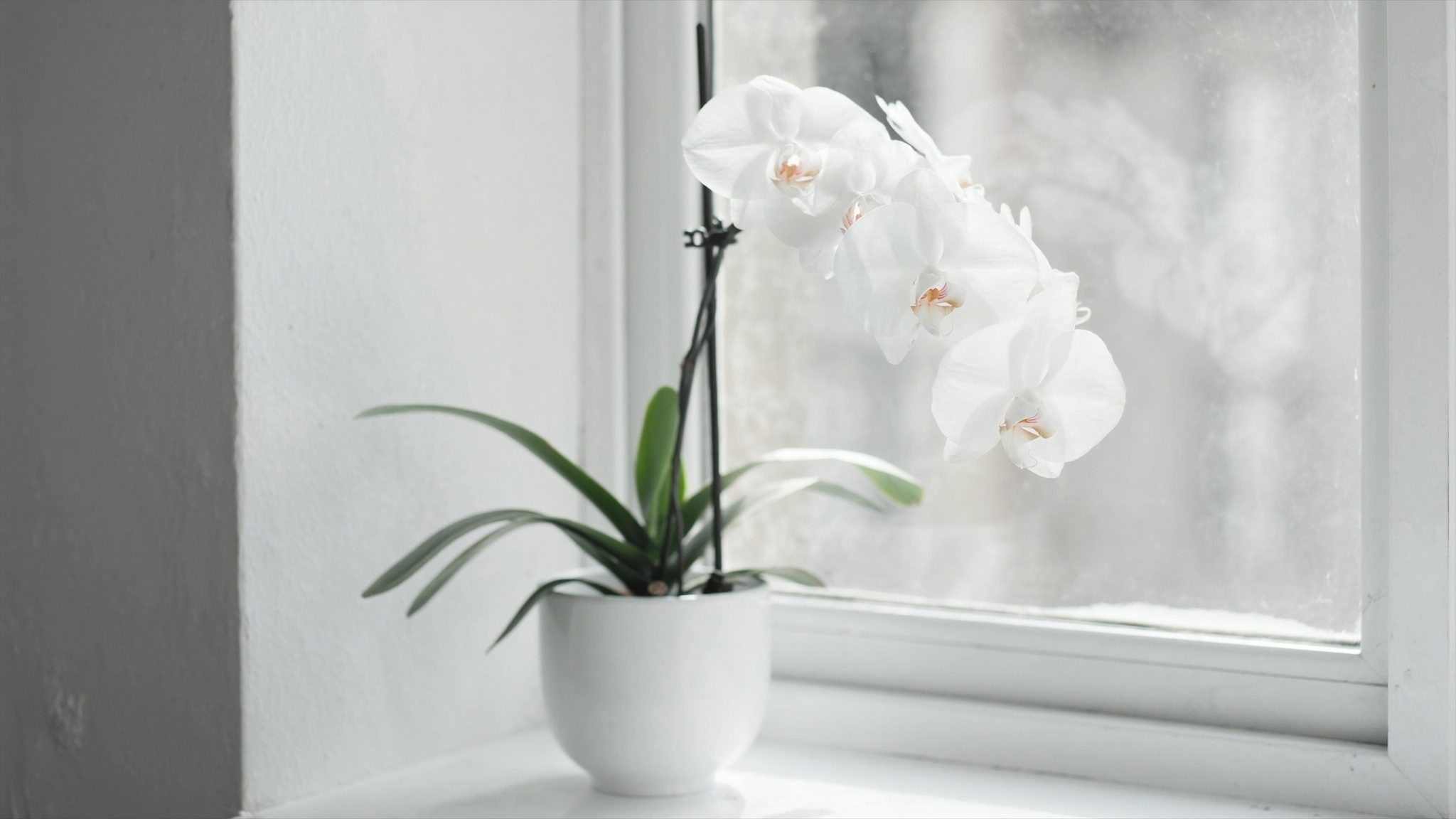
The phalaenopsis, often called the moth orchid, is the most common orchid kept at home, and for good reason: it is happy at normal room temperature, flowers for a long time and is not difficult to look after once you know a few rules. Most are lost not through neglect but through too much water.
The essentials
- A bright spot without direct midday sun.
- Water by soaking when the roots turn silvery grey. In a flat that is usually every 7–10 days.
- Never leave water standing in the pot or at the bottom of the decorative outer pot.
- Around 18–25 °C, away from radiators.
- A clear pot and bark mix, not ordinary potting soil.
Light
An east- or west-facing windowsill is ideal. On a south-facing sill the summer sun can scorch the leaves, so either filter it with a sheer curtain or move the plant back from the glass. A north-facing window is fine in summer, but in a Lithuanian winter there is often too little light there and the orchid may not flower.
The leaves tell you whether the light is right. Healthy leaves are a medium green and firm. Very dark green, long and floppy leaves mean too little light, while yellowish leaves or dry brown patches mean too much sun.
In winter, do not let the leaves touch the cold window glass, and protect the plant from cold air when you air the room.
Watering by soaking
In nature phalaenopsis roots grow on tree trunks, getting soaked and drying out quickly. Soaking copies that at home.
- Lift the plastic pot out of the decorative outer pot.
- Stand it in a bowl of room-temperature water, with the water reaching almost to the top of the bark.
- Leave it for about 10–15 minutes so the bark can absorb water.
- Lift it out and let it drain completely. Only then put it back in the outer pot.
How often? Look at the roots, not the calendar. Dry roots are silvery grey or whitish, and wet roots turn green. Water when the roots have gone grey again and the pot feels light when you pick it up. In a flat that is usually every 7–10 days, sometimes more often during the heating season and less often in a cool room.
Water in the morning so the leaves are dry by evening. Do not let water sit in the crown, the point where the leaves meet in the centre: standing water there can cause rot. If some gets in, dab it out gently with a paper towel.
Humidity and the heating season
Phalaenopsis prefer more humid air than a typical flat, roughly 50–70 percent. In Lithuania, from October to April when central heating is on, indoor air is much drier than that. This is a common reason why buds drop in winter and leaves lose their firmness.
What you can do:
- Do not put the orchid directly above a hot radiator. If the radiator is under the windowsill and there is no other bright spot, stand the pot on a tray of pebbles with water in it. The pot should sit on the pebbles, not in the water.
- Group several plants together.
- If you have a humidifier, it will help the orchid as well as you.
- Misting the leaves is not necessary. The effect is short-lived, and water running into the crown can do harm.
The clear pot and aerial roots
Orchids are sold in clear plastic pots for a reason. Phalaenopsis roots are green and take part in photosynthesis, and a clear pot lets you see at a glance whether they are dry or still wet. So do not plant the orchid straight into a ceramic pot. Instead, stand the clear pot inside a nice ceramic outer pot and lift it out when you water.
Aerial roots growing above the pot are completely normal. Do not cut them off or try to force them into the bark. Only cut away, with clean scissors, roots that are completely dried out and papery, or soft, brown and rotten.
Repot roughly every two years, when the bark starts to break down or the roots no longer fit the pot. The best time is after flowering. Use a special orchid bark mix, never ordinary soil.
Feeding
Use a fertiliser made for orchids, following the instructions, and if in doubt make it weaker than recommended. While the plant is actively growing new leaves, roots or a flower spike, feeding every 2–4 weeks is enough. When it is resting, feed less or not at all. Never feed dry roots: water first, or the fertiliser can burn them.
After flowering: what to do with the spike
Phalaenopsis flowers often last several weeks and quite often a couple of months. When the last flowers drop, you have a few options.
- If the spike turns yellow or brown and dries out, cut it off at the base.
- If the spike stays green, you can cut it about 1–2 cm above the second or third node, counting from the bottom. A side spike sometimes grows from that node and the orchid flowers again.
- You can also cut a green spike off at the base. The plant then rests and puts its energy into leaves and roots, and the next flowering is often stronger.
Cooler nights often help a new spike to appear, meaning a few weeks where nights are several degrees cooler than days.
Common mistakes
- Watering too often and leaving water in the outer pot. The roots rot and the leaves go limp, which looks like thirst but is the opposite.
- Repotting into ordinary soil. The roots get no air and rot quickly.
- Cutting off aerial roots.
- Moving the plant while it has buds. A sudden change of light or temperature can make the buds drop before they open.
- A spot next to a radiator or a fruit bowl. Dry heat and the ethylene from ripening fruit shorten flowering.
- Too much fertiliser.
- Worrying about one yellow lower leaf. An old bottom leaf sometimes yellows naturally. If several leaves yellow at once, check the roots.
Orchids in Kaunas
At Gitanos gėlės, inside the Šilas supermarket at A. Baranausko g. 26, Kaunas, you will find potted plants, including orchids, from 8 €, alongside cut flowers. The stand is open every day 8:00–23:00. If you would like a bouquet as well, you can pre-order it by SMS on +370 656 38880 or on gitanosgeles.lt.